

Where Is the “Last-Mile” E-Mobility Solution We Were Promised (in 2008)?
“Built for use around airports, this scooter attracted the attention of Amelia Earhart Putnam and her pupil, June Travis, the day Miss Earhart gave June her first flying lesson in 1935.”
Look at this photo. Really look at it. This was from 1935.
So, nearly 100 years ago… we had this….
Amelia Earhart standing on a small motorized scooter built for use around airports. Simple. Mechanical. Useful. It is not trying to impress anyone with a paired phone app. It’s not buried under cheap plastic. It is not hiding behind fake range numbers, mystery, unsourceable parts, and “smart mobility” buzzwords.
It is a simple 2 wheels and handlebars machine built to move people.
That was the whole point.
So here lies the question ScooterOps cannot and will not stop asking:
If we had this idea nearly a century ago, why are we standing for (and standing on) all of this imported disposable Chinese crap being pushed on American metropolitan riders today?
The e-scooter industry loves to act like it invented the future. It did not. Small personal transportation has been around for generations. The word ‘Micromobility” is new, but the idea of getting around simply and easily not. The need is not new. The last-mile problem is not new. I mean, the Obama pushed clean energy back in 2008 and we still don’t have a dependable, repairable “Cadillac” of an American made e-scooter model.
Like seriously, WHERE’S THE E-SCOOTER CADILLAC we were promised in the Obama Admininstration?
People need a simple way to move short distances. Home to train station. Apartment to grocery store. Campus to class. Airport terminal to hangar. Subway stop to work. Restaurant shift to home. Beach town, city block, warehouse, neighborhood, delivery route, parking lot, job site, marina, campus, boardwalk, downtown strip. Literally anywhere. And any age.
You know, the actual “last-mile” promise that we all need.
And somehow, with all of this fancy schmancy battery technology, effiiciency in brushless motors, controllers, digital displays, aluminum frames, global supply chains, and modern manufacturing, the industry and country still has yet to deliver the obvious product most people actually need.
Do you think you have a good e-scooter?
Let me to ask these 3 questions:
Was it under $600?
Does it go 22-25 MPH with ACTUAL 22-25 Mile Range?
Does it have dependable Tires and Electronics?
No, No, and No. Sad.
In 5 years of repairing hundreds of E-Scooters in Phoenix, Arizona. The only e-scooter that came close to these 3 tick boxes was the Isinwheel X3 Pro…
And guess what.
You can’t buy it anymore. I wonder why?
So yeah again, where is the under-$600 e-scooter (or e-bike) SOLUTION that is mobile, dependable, repairable, and honest? (And preferable made in America…)
Where is the simple wheels and handle bars machine that can actually go 22 to 25 miles per hour? That cousins we had a century ago…?
Where is the real 22 to 25 mile range with a human rider, real payload tested (not tested riderless on a treadmill), real pavement, real hills, real stop-and-go riding, and real weather?
Not, you know, “up to 25 miles” if the rider weighs 90 pounds, rides downhill, never brakes, never accelerates, and apparently lives inside a wind tunnel.
Real range. On a real road.
And while we are asking the obvious questions, where are the dependable tires?
Not tubeless tires that become a repair war. Not solid tires that ride like punishment and require a medieval crank machine to install. Not cheap tubes that pop every time the rider looks at a pothole. Not weird tire sizes nobody can source. Not wheels designed so badly that a flat tire turns into a full disassembly project.
Dependable, Serviceable, High Quality Rubber tires. (like MICHELIN)
Tires designed around the end user instead of the manufacturer’s sales page.
This is where the e-scooter industry keeps failing, and, borderline tricking us.
It talks about freedom, but sells dependency.
It talks about mobility, but sells fragile gadgets.
It talks about sustainability, but builds and sells us machines that become electronic landfill waste in typically under 2 years.
It talks about innovation, but cannot seem to give normal riders a simple, durable, affordable last-mile vehicle that can survive daily use and be repaired without a treasure map.
That is not progress.
That is a business model wearing a helmet.
The modern e-scooter market is flooded with models that look good online and fall apart in the real world. Cheap hardware. Bad access. Poor wiring layouts. Overcomplicated tire systems. Weak brakes. Mystery controllers. Bad waterproofing. Oddball parts. Screws hidden under stickers. Plastic covers over plastic covers. Designs that make basic service feel like surgery.
Then the industry acts shocked when riders stop trusting the product.
Why would they trust it?
A rider does not need a spaceship. A rider needs a dependable short-range transportation machine.
That means a frame that can handle daily abuse. A battery that gives honest range. A motor that can move an adult rider at a practical speed. Brakes that make sense. Tires that do not turn ownership into a hostage situation. Parts that can be sourced. A design that can be repaired.
That is the list.
That is the whole damn assignment.
This should not be complicated.
For under $600, the industry should be fighting to build the people’s last-mile machine. Not another fragile Chinese toy. Not another imported clone with a different logo slapped on the stem. Not another “premium” scooter that needs specialty tools and dealer-level patience to fix basic problems.
A real last-mile scooter should be honest.
It should run 22 to 25 miles per hour.
It should deliver 22 to 25 miles of true range with a real rider and payload.
It should have dependable tires that are serviceable, sourceable, and built for actual pavement.
It should be simple enough for a rider to understand and a repair shop to service.
It should not become landfill because of a flat tire, dead controller, broken throttle, stripped screw, or one hard-to-source part.
That is the standard.
And the reason this 1935 photo hits so hard is because it proves the spirit and demand was already there and has been there for a century.
The old model wasn’t perfect. And looks like it was gas-powered, but it had the right idea. It was practical transportation. It was built around movement, not marketing. It was a machine first and a product second.
Today, too many e-scooters are the opposite.
They are products first and machines second.
That is the rot.
A real machine is built to work. A real machine is built to be maintained. A real machine respects the person who owns it.
A bad product just wants to be sold.
And that is exactly why ScooterOps keeps screaming about repairability.
Repairability is not a side feature. It is the difference between transportation and trash. If a scooter cannot be fixed, it is not serious mobility. It is a disposable gadget with handlebars.
The e-scooter industry had a golden opportunity. It could have created the most practical personal transportation category in America. Affordable, small, efficient, easy to store, easy to ride, easy to repair, and perfect for short trips.
Instead, it flooded the market with imported junk, fake specs, tire nightmares, and machines that punish the owner the moment the warranty clock starts ticking.
Nearly 100 years after Amelia Earhart stood on a scooter built for airport mobility, we should be miles ahead.
Instead, we are still asking the basic question:
Where is the dependable last-mile machine?
Not the fastest.
Not the flashiest.
Not the most “connected.”
The most honest.
Give riders a machine under $600 that can move 22 to 25 miles per hour, deliver 22 to 25 real miles of range, carry an actual adult, survive real roads, use dependable tires, and be repaired without nonsense.
That is the e-mobility solution people need.
And until the industry builds it, ScooterOps will keep calling out the garbage. Which is mostly all of it. Except GoTrax.
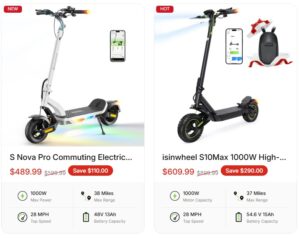
Although these 2 models from Isinwheel look promising I will keep an eye out for them: