E-Scooter Industry Exposed: Why Tubeless Tires or “Solid Tires” Are a Total Scam
The e-scooter industry loves selling riders on buzzwords. Especially us “American Consumers…
More range. More speed. More “premium” features. More futuristic nonsense packed into scooters that somehow still fall apart when they touch one bad pothole.
And one of the biggest scams hiding in plain sight?
Tubeless tires — and, in plenty of cases, solid tires too.
In theory, tubeless tires sound great. No inner tube. Better puncture resistance. Less maintenance. More durability. Solid tires, sometimes marketed as the “never flat” solution, sound even better to a frustrated rider who has already dealt with one or two flats.
That is the sales pitch. That is the clean little bullet point manufacturers slap on the product page to make the scooter sound more advanced than it actually is.
But in the real world, where people ride over broken glass, cracked pavement, construction debris, curbs, bad sidewalks, and mystery road shrapnel, tubeless tires and solid tires are often not premium upgrades.
They are repair nightmares dressed up as innovation.
At ScooterOps, we see the reality. Riders are not walking in with marketing brochures. They are walking in with flats, leaks, damaged beads, stubborn tires, bent rims, stripped hardware, destroyed wheels, and scooters that were clearly designed by people who never had to fix one on a bench.
That is where the tubeless and solid tire myth starts to fall apart.
With a normal tube tire, the repair path is annoying but understandable. The tire comes off. The tube gets replaced. The tire goes back on. Nobody loves doing it, but at least the system makes sense.
Tubeless scooter tires are a different animal. Solid tires can be even worse.
The industry wants riders to believe they are getting motorcycle-level tire technology, or some magical flat-proof solution, on a compact electric scooter. But most of these scooters do not have motorcycle-level rims, service access, tolerances, or engineering. They have tiny wheels, stiff tires, awkward motor assemblies, and designs that make a basic tire job feel like a punishment.
And here is the part nobody wants to say out loud.
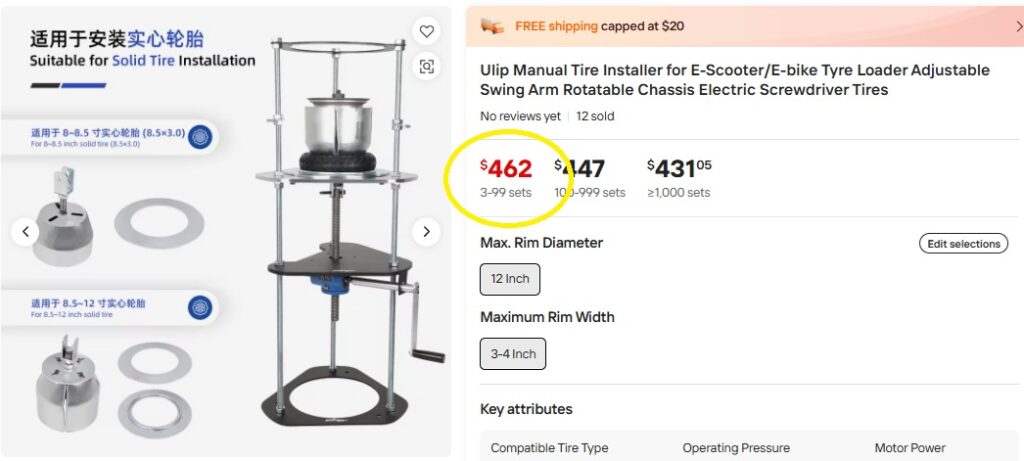
The only real way to reinstall many of these tubeless tires, or force on certain solid tires, is with a specialized crank-style tire machine.
A machine that costs around $300.
A machine most riders do not have.
A machine most small repair shops do not have.
And, even better, a machine that is not exactly sitting on the shelf at every hardware store waiting to save the day.
So what happens?
The rider gets a flat. Or the rider gets sold on a solid tire conversion because they are tired of flats. The tire comes off, if you are lucky. Then comes the ugly part: getting that thick, stiff, miserable tubeless tire or solid tire back onto a tiny scooter rim without damaging the tire, bending the rim, destroying the bead, wrecking the motor wheel, or losing your mind in the process.
This is not normal maintenance. This is not rider-friendly design. This is a repair trap.
And that is the scam.
Manufacturers sell tubeless tires like they solved the flat tire problem. They sell solid tires like they eliminated it completely. They make both options sound cleaner, stronger, smarter, and more advanced. But when the tire actually needs service, the customer finds out the truth: the system often requires special tools, extra labor, more frustration, and a repair process that the average rider has absolutely no chance of handling themselves.
Tubeless does not mean flat-proof.
Solid does not mean problem-proof.
Read that again.
Tubeless does not mean flat-proof, and solid does not mean problem-proof.
A tubeless tire can still puncture. It can still leak. It can still fail at the valve stem. It can still lose air around the bead. It can still refuse to seat properly. It can still become useless if the rim is even slightly compromised.
A solid tire will not go flat, sure. Congratulations. But it can ride worse, stress the wheel harder, make the scooter feel rougher, and turn installation into an absolute war. In some cases, solid tires do not solve the problem. They just trade one headache for another.
That is the problem with this industry. It loves selling features that sound good online but make no sense once the scooter actually needs repair.
A tube tire might not sound fancy, but at least it is honest. It is simple. It is serviceable. It gives the rider and the repair shop a logical path forward.
A tubeless tire, or a solid tire, can turn into a wrestling match against rubber, metal, air pressure, heat, clamps, tire spoons, straps, and bad design. You can fight with every trick in the book. But at the end of the day, many of these tires were never meant to be easily reinstalled by a normal person with normal tools.
So why are they everywhere?
Because they look better on a spec sheet.
Because “tubeless tires” sounds premium.
Because “solid tires” sounds bulletproof.
Because it helps sell scooters.
Because companies can pretend they improved reliability while quietly dumping the real-world repair burden onto the customer.
That is not innovation. That is marketing with a socket wrench stuck in its throat.
The worst part is that many of these scooters are already built like disposable electronics. Tight wiring. Poor access. Cheap hardware. Awkward motor wheels. Bad rim design. Parts that are hard to source. Repairs that should be simple but turn into surgery.
Then they add tubeless tires, or solid tires, on top and act like they did the customer a favor.
They did not.
They made the scooter harder to fix.
And any transportation product that becomes harder to fix becomes worse for the rider.
At ScooterOps, we care about what happens after the sale. We care about whether the scooter can actually be serviced. Can the wheel come off? Can the tire be changed? Can the parts be sourced? Can the customer get back on the road without getting financially body-slammed by a bad design decision?
Those are the questions that matter.
Speed is fun. Range is nice. Suspension is cool. App connectivity is cute. But if your scooter needs a rare $300 crank machine just to make a tire replacement realistic, then we are not talking about convenience. We are talking about a design choice that punishes the end user.
That is why repairability matters more than almost every other spec.
A real commuter scooter needs to survive the road. More importantly, it needs to be fixable when the road wins.
Tubeless tires can make sense in certain applications. Solid tires can make sense in certain applications too. On better-built machines, with proper rims, proper tolerances, proper ride design, and proper service equipment, they can work.
But on a lot of electric scooters, they are being used as fake premium features. The customer sees “tubeless” and thinks they are getting durability. The customer sees “solid” and thinks they are getting freedom from flats. Then they need service and discover they bought themselves a repair problem with handlebars.
Before buying your next electric scooter, do not just ask how fast it goes. Do not just ask how far it rides. Do not get hypnotized by tubeless tires, solid tires, app connectivity, or whatever shiny nonsense the industry is pushing this week.
Ask the question that actually matters:
When this thing breaks, can it be fixed?
Because if the answer is no, you are not buying freedom.
You are buying a future headache with a throttle.